
Rehabilitation medicine
Doctors in rehabilitation medicine assess and treat patients with complex disabling conditions.
You’ll experience a demanding and varied role with the goal of optimising a patient’s recovery after a severe injury, improving their capabilities and ability to participate in society.
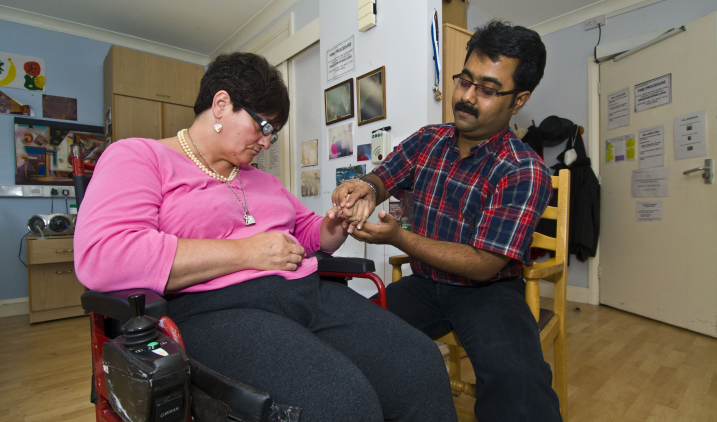
Life as a doctor in rehabilitation medicine
You’ll deliver neurorehabilitation treatment to patients with neurological conditions such as traumatic brain injury, stroke, multiple sclerosis and spinal cord injury.
Treating patients with such a wide and varied range of conditions demands an excellent diagnostic ability. You’ll need to manage both acute and chronic complications and be able to take a long-term view to a patient’s care. Doctors in rehabilitation medicine often work with a patient from immediately after an acute event through to discharge and rehabilitation in the community.
- hyper-acute rehabilitation – taking patients directly from critical care services
- major trauma rehabilitation and rehabilitation along the acute care pathway
- assessment and management of patients with disorders of consciousness
- closer working relationships between neurological rehabilitation and other services including spinal cord injuries centres, clinical neurosciences, stroke medicine
- improved skills in the management of chronic pain
- end-of-life care in patients with complex disability
- interactions with the courts for medico-legal issues including litigation and mental capacity, best interests decision-making, deprivation of liberty, etc.
- further differentiation of specific fields of interest within the specialty including further development of musculoskeletal rehabilitation and increased focus on vocational rehabilitation
- further development of community-based specialist services
Rehabilitation medicine is a highly rewarding specialty. The long-term nature of treatment will allow you to get to know your patient and their family and deliver first-class, holistic care.
How much can I earn?
How about the benefits?
- make a difference
- flexible and part-time working
- high income early in your career
- work anywhere in the world
- excellent pension scheme
- good holiday entitlement
- NHS discounts in shops and restaurants
Must-have skills
- excellent communication skills to manage a wide range of relationships with colleagues, and patients and their families
- emotional resilience, a calm temperament and the ability to work well under pressure
- teamwork and the capacity to lead multidisciplinary teams
- problem-solving and diagnostic skills
- outstanding organisational ability and effective decision-making skills
- first-class time and resource management for the benefit of patients
In addition, doctors in rehabilitation medicine need to demonstrate:
- analysing and solving complex clinical problems
- a holistic approach to patient and family care
- patience, enthusiasm and optimism
- empathy and sense of humour
Entry requirements
If you already have a degree, you could study for a four-year postgraduate degree in medicine.
You’ll need to pass an interview and admissions test. You’ll be asked to show how you demonstrate the NHS values such as compassion and respect.
Some medical schools look to recruit a mix of students from different backgrounds and geographical areas, so your educational and economic background and family circumstances could be considered as part of your application.
What are my chances of starting a career as a doctor in rehabilitation medicine?
How to become a doctor in rehabilitation medicine
After your foundation programme, you can apply for paid specialty training to become a doctor in rehabilitation medicine, which will take a minimum of six years.
You may be able to train part time, for example for health reasons or if you have family or caring responsibilities.
Where a career as a doctor in rehabilitation medicine can take you
- get involved in research at universities, the NHS or private sector
- teach medical students or postgraduate students in training
- develop medico-legal or private clinical practice