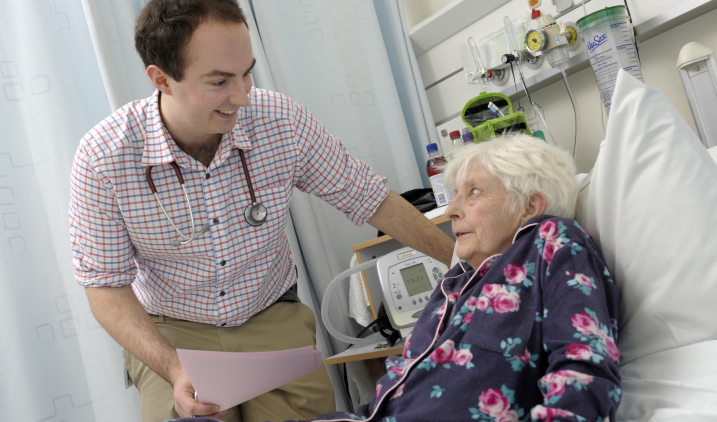
This page introduces you to Foundation training, provides details of the application process and advice on choosing your Foundation school. You can also find out about the Academic Foundation Programme.
After completing your undergraduate medical degree, the next part of your training as a doctor involves the two year Foundation Training programme. This is in effect your first paid job as a doctor.
The training comprises foundation year one (F1) and foundation year two (F2). After successful completion of F1 you will be able to apply for full registration with the GMC.
The foundation programme usually involves six different rotations or placements in medical or surgical specialties. These rotations enable you to practise and gain competence in basic clinical skills. You’ll also be able to develop non-clinical skills such as communication and team work whilst gaining experience in a number of specialty areas.
you will have to apply through a national application process. The Foundation Programme website has full details
if you are currently studying at a UK medical school they will provide you with the relevant information and will be responsible for nominating you for the application process
you will need to make an online application in the autumn for a Foundation Programme commencing the following summer. Key dates can be found in the UKFPO Applicant's Handbook
you will have work-based assessments and record these in a learning e-portfolio
irrespective of the placements you have completed, all doctors must achieve the same general clinical and non-clinical competencies
you will experience a broad range of workplaces, including acute, community, mental health and general practice settings
four placements each of three months (or possibly two placements of six months) need to be completed. These will be in different areas to help you choose which specialty to follow after foundation training
you should have three hours per week timetabled learning
On your application for Foundation Training you will need to rank all of the Foundation School geographical areas in order of preference.
The decision regarding the Foundation School to which you will be allocated will depend on a computer generated ranking via the Oriel system (PIA - preference informed allocation).
location - do you want to stay local or move away? Do you have any dependants or family commitments? Check the relevant guidance documents or individual Foundation school websites to see if you may have to move hospitals between F1 and F2.
type of Hospital Trust – inner-city or rural?
competition – some areas of the country are more popular, eg London
number of posts available – this can differ from area to area
Although you do not choose these at application stage you should research the different programmes offered by individual schools. Once you are allocated to a Foundation School they will ask you to indicate your preferred programmes.
If you don’t get the specialty you want, it may be possible to do a taster (two to five days) during the last rotation of F1, or during your F2 year.
Get help with making an informed decision about your specialty
Specialty explorer is a tool for British Medical Association members that supports your research into medical specialties and provides you with a personalised report. It's quick, easy to use and covers all specialties in the UK.
Reflect on what matters to you most through a series of questions. Your personalised report will detail 10 specialties that match your preferences prompting you to think about specialties you may not otherwise have considered. You’ll also receive details about where to find further support, so you can focus your research.
NB. Specialty explorer is not designed to be used in isolation. The BMA encourages you to seek further career support when choosing your specialty. The tool is intended to be used in combination with other sources of career advice, such as: clinicians, postgraduate deaneries, royal colleges, BMA resources and other sources such as NHS Health Careers.
You can also use the "interests tool" in the log-in area of this site.
This is a programme for those who achieve a high academic standard in their undergraduate medical degree and would like a university-based academic career.
Entry is very competitive and there are fewer programmes to choose from.
This form is for you to tell us about something that could be improved about the website or if there's anything wrong, incorrect or inaccurate with what you see.
If you have a query about a career in the NHS, please visit our contact us page and call or email us.