Introduction

Points to consider when deciding
whether to study medicine
This is a guide for those who are considering
medicine as a career. This information will be relevant whether you
are still at school and thinking of applying to do a degree in
medicine or if you are a graduate in another subject and are
considering applying for the accelerated graduate entry programme
to medicine. We have some specific information on these pages and
also by looking at the general guidance given on this website we
trust that you can get a flavour of what it is like to study and
train in medicine, as well as getting an overview of what it is
like to work in the different medical specialities.
- Medicine is a science, therefore you will need to be have
strong scientific ability (or the skills to develop this ability –
this is particularly relevant to entrants who are selected from a
non-science/traditional background)
- You must also possess the capacity to learn and to retain large
amounts of information
- You will need good analytical and reasoning skills
- Much of the work is patient-focused and involves teamwork with
other healthcare professionals. Therefore you are required to have
good people skills
- Medical practice requires lifelong learning and the work can be
challenging. Therefore you must be highly motivated by a strong
interest in medicine
- Other skills required are time-management, leadership and an
enquiring and critical mind (these are skills that you will learn
as you progress through medical school)
- It is very competitive to get into medical school, and if you
are applying from school, 6th form college or a college
of further education you will need to have good A-level results (or
equivalent qualifications), and usually have studied sciences. The
majority of medical schools require A levels in chemistry, whilst
others will accept AS level in chemistry, depending upon the other
qualifications being offered. Some require biology at A’ level. See
the NHS
Careers website for further guidance.
- Many medical schools in the UK also require that you take the
UKCAT (UK Clinical Aptitude Test) or
the BMAT (Bio-medical
Admissions Test). These are aptitude tests i.e. a test of your
mental ability, rather than an academic test of your
knowledge.
- If you are a graduate thinking of entering via the accelerated
programme you do not necessarily have to have a first degree in a
science to gain admission – although this varies depending on the
medical school, and these places are highly competitive.
- It will also help in your UCAS (Universities and Colleges
Admissions Service) application to have other non-academic
interests to show that you are well-rounded as a person. UCAS is
the organisation responsible for managing applications to higher
education courses in the UK. (See our section on: Applying to Medical School).
- Medical schools are encouraging widening
participation to attract, support and enable greater numbers of
disabled students and so to encourage a more diverse medical
workforce.
- The Medical Schools Council also provides the following
guidance:
'Applicants are encouraged to seek advice
from the Medical Schools as early as possible to facilitate timely
consideration. A history of serious health issues will not
jeopardise a career in medicine unless the condition impinges on
professional fitness to practise. In addition to the Medical
Schools, the disability centre within the University can also
advise disabled applicants.' (see point 6 in
Guiding
principles for the admission of medical students).
- Medicine is one of the most highly respected professions and
the majority of doctors find their work highly rewarding and
enjoyable
- After graduation from university, if you choose to work as a
doctor, you will be paid a reasonable salary during your training
which will increase as you become more experienced. The
NHS
Careers website has up-to-date information on remuneration
- There are over 60 different specialties in medicine, and there
are many differences between each specialty so there is a high
likelihood that you will find a role which is suited to your
particular personality and interests. Even when you choose a
specialty there are many different roles within that specialty. For
example, if you choose to become a GP, you could become a GP with a
special interest in a particular area of medicine
- In addition there are also opportunities to get involved with
teaching, management and research if you are interested in any of
these areas
- Historically, there has been good job security working as a
doctor in the NHS – it has not been as affected by recession as the
private sector
- There is a strong supportive system in place for medical
students and trainee doctors, overseen by the medical school,
the local education and training boards (LETBs) and the
GMC (General Medical Council). During your training you will be
helped and supported by your designated tutors, educational
supervisors and clinical supervisors as well as the director of
medical education for your NHS Trust
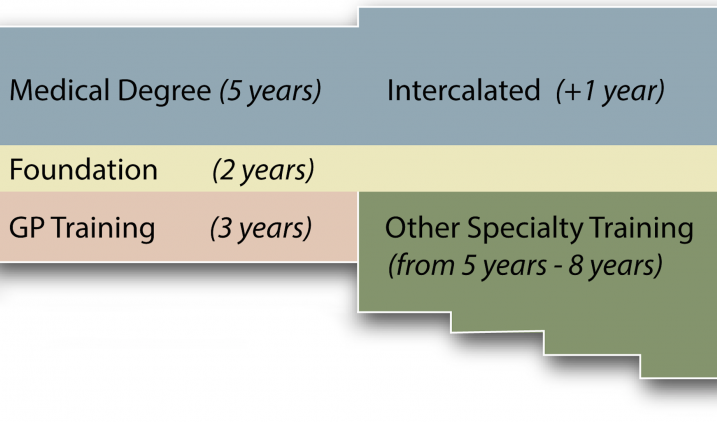
- After graduating from medical school, it will take several
years to train to become a GP or hospital consultant (see our
section on
the length of training)
- In some specialties, it is very competitive to gain a training
place. If you opt for a very competitive specialty, you will need
to be prepared to work especially hard during your training.
However, the good news is that you do not need to choose which
specialty you wish train before or whilst at university. This sort
of choice is made after medical school; at present it is made
during the second year of post-graduate medical training, although
planning ahead and considering all your options is encouraged from
the earliest stages
- Patients become ill and need care at all times of the day and
night, 365 days a year! The hours are generally longer than the
average 9-5 job and you sometimes have to work unsociable hours,
both during your training and throughout your working life
(although this depends on the specialty you choose and there are
also options for part time working).There have been major changes
recently and doctors now should generally not work any more than 48
hours per week
- You will need to be emotionally resilient to deal with
patients’ suffering and death. You will also need support their
families through these periods
- If you go to medical school you may be concerned about the
financial implications around not earning any money for
approximately five years while you are studying, and the level of
student debt that you may acquire. However there are student loans
and also some grants available; information on these can be found
on the Money4MedStudents
website
- You should think carefully about what type of doctor you want
to be. Do you want to work in primary care (i.e. in the community)
or in secondary care (i.e. in a hospital-based role)? Patients'
needs and consequently the needs of the service are changing; we
have an aging population, and many patients have chronic
conditions. Much of this care will be delivered in the community,
so currently 50% of the specialty training opportunities are in
general practice (click here to watch a
short video about general practice), and there will be
increasing needs for elderly care specialists. Mental health
problems are also common and there are increasing opportunities for
those who are interested in specialising in psychiatry. Not
everybody who wants to be a surgeon will have the opportunity to
become one
- Training in medicine will often demand that you are very
flexible. For example throughout your training you may have short
stints working in different hospitals (although they will be in
roughly the same region). This could mean that you have to
move from area to area, living in one place for four months or so,
before having to move again, and this has implications for your
family life.
You can view the pane to the top left for further
information for young people and students considering
medicine.
Don't forget to read
our case-studies: they are written by medical students who were
asked to say why they chose to study medicine.